If you’ve ever read a medical article or heard someone use the word “fetus”, you might have wondered where it actually comes from. I remember seeing the term in a biology textbook and thinking it sounded strangely elegant — like it had an older, deeper meaning behind it. That curiosity led me to check its Latin origin. If you’re here, you’re likely doing the same: searching “what does fetus mean in Latin” to understand what this word really meant originally.
So, let’s break it down clearly and simply.
Quick Answer:
“Fetus” in Latin means “offspring,” “bringing forth,” or “the act of giving birth.”
It refers to a developing young and carries a meaning related to growth, production, and creation.
🧠 What Does Fetus Mean in Latin?
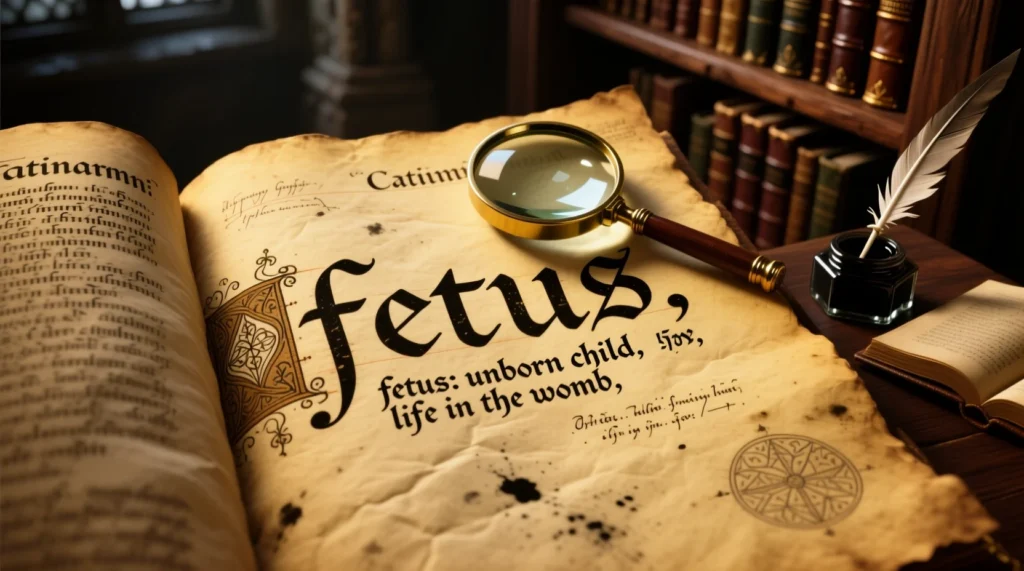
In classical Latin, the word “fetus” (sometimes spelled foetus in older English) means:
- offspring
- bringing forth
- youth
- the act of birth
- fruit or produce of something
It comes from the broader Latin idea of growth, creation, and development.
Example Sentence:
“In Latin literature, fetus was used to describe the young offspring of humans, animals, and even plants.”
In short: fetus (Latin) = offspring + growth + bringing forth.
📱 Where Is This Meaning Commonly Used Today?

The Latin meaning of fetus appears in:
- 📘 Biology textbooks
- 🏥 Medical terminology
- 🧬 Embryology discussions
- 📚 Historical literature
- 🗣️ Linguistic explanations
Formality level:
✔ Formal
✔ Academic
✔ Scientific
❌ NOT used in casual texting or slang
💬 Examples of How the Word Is Used in Context
- “The term fetus comes from Latin, meaning offspring or bringing forth.”
- “In early medical texts, fetus referred broadly to any developing young.”
- “Latin scholars interpreted fetus as the product of conception.”
- “The English word inherited the meaning of growth before birth.”
- “Plants producing new growth were sometimes described with words related to fetus in old Latin.”
- “The Latin fetus connects to several modern scientific terms involving development.”
🕓 When to Use and When NOT to Use the Word
✅ Use “fetus” when:
- Discussing medical or biological development
- Writing academic or scientific content
- Referring to the human or animal developmental stage
- Explaining Latin word origins
- Using proper scientific terminology
❌ Do NOT use “fetus” when:
- Speaking casually in conversation
- Describing newborns (they are no longer fetuses)
- Referring to plants (modern English no longer uses the word that way)
- Using slang or informal messaging
- Talking about philosophical or political interpretations unless contextualized carefully
Comparison Table
| Context | Example Phrase | Why It Works |
|---|---|---|
| Biology | “The fetus develops major organs by week 10.” | Correct scientific usage |
| Latin meaning | “Fetus originally meant ‘offspring’ in Latin.” | Linguistically accurate |
| Academic writing | “The term has roots in classical Latin.” | Formal and relevant |
| Casual chat | “My friend’s baby is a fetus now.” | ❌ Sounds too clinical |
| Newborn description | “This fetus is cute.” | ❌ Incorrect stage of development |
🔄 Similar Words or Related Terms
| Term | Meaning | When to Use |
|---|---|---|
| Embryo | Early stage before fetus | Medical/scientific contexts |
| Neonate | Newborn | After birth |
| Infant | Baby under 1 year | Everyday and medical usage |
| Gestation | Pregnancy period | Scientific or formal writing |
| Offspring | Child of any species | Formal or general content |
| Progeny | Descendants | Biological or literary use |
❓ FAQs About the Latin Meaning of “Fetus”
1. Is “fetus” originally a Latin word?
Yes. It comes directly from classical Latin.
2. Does it mean the same thing in Latin as in English?
Partly. Latin includes broader meanings like growth and production.
3. Is “foetus” the correct spelling?
“Foetus” is an older British spelling, but fetus is now standard globally.
4. Did Romans use the word for plants too?
Yes, they sometimes used it metaphorically for plant growth or produce.
5. Is the meaning connected to pregnancy only?
In Latin, no — it included general offspring and creation.
📝 Conclusion
The word fetus comes from the Latin term meaning offspring, growth, and bringing forth. While modern English uses it strictly in a biological and medical sense, its Latin roots represent a much broader idea of development and creation. Understanding the original meaning gives a deeper appreciation of scientific terminology and how language evolves over time.