Have you ever heard the term “mutually exclusive” in a conversation, a business meeting, or while reading an article, and wondered what it actually means? You might have paused and thought: “Are these two things really opposites?”
Whether in statistics, logic, or everyday language, mutually exclusive is a term that can confuse many people. This guide explains what it means, how it’s used in different contexts, examples you can relate to, common mistakes, FAQs, and a mini quiz at the end so you’ll never be confused again.
Quick Answer:
Mutually exclusive means two events or ideas cannot happen at the same time. It’s a clear, logical concept used in math, probability, logic, and everyday decision-making.
🧠 What Does Mutually Exclusive Mean?
The term mutually exclusive refers to situations where if one event occurs, the other cannot.
Example in statistics:
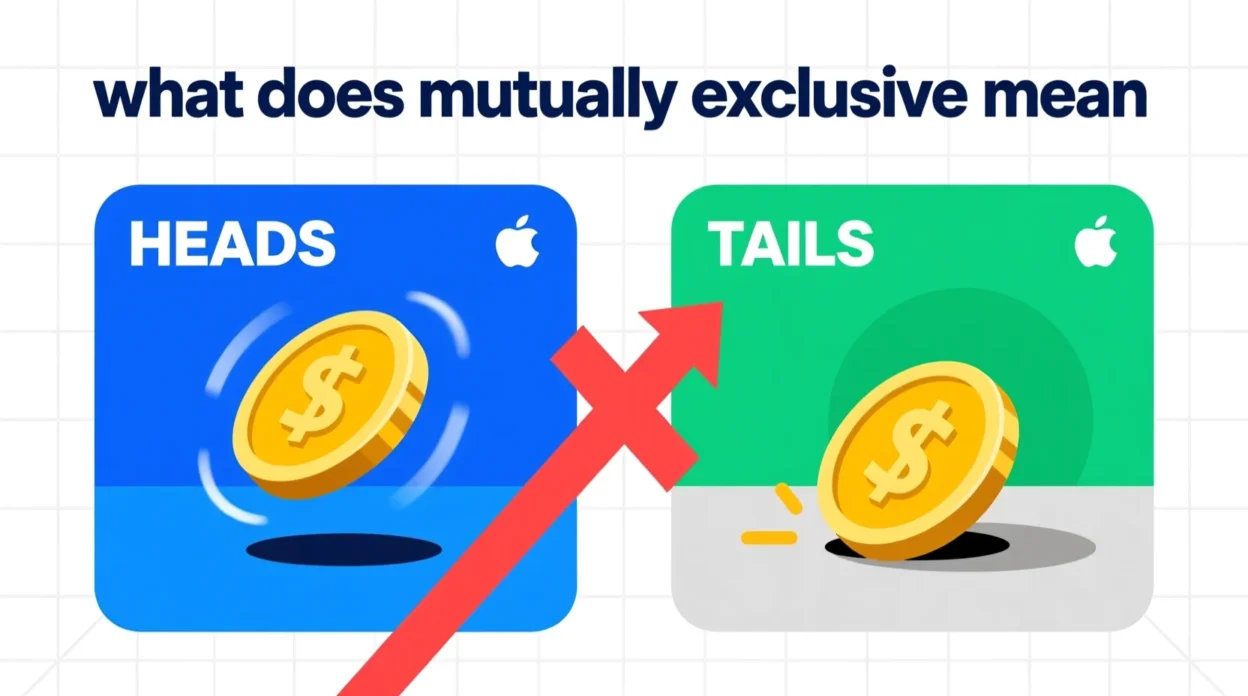
When flipping a coin, getting heads and tails on the same flip is mutually exclusive.
Example in everyday life:
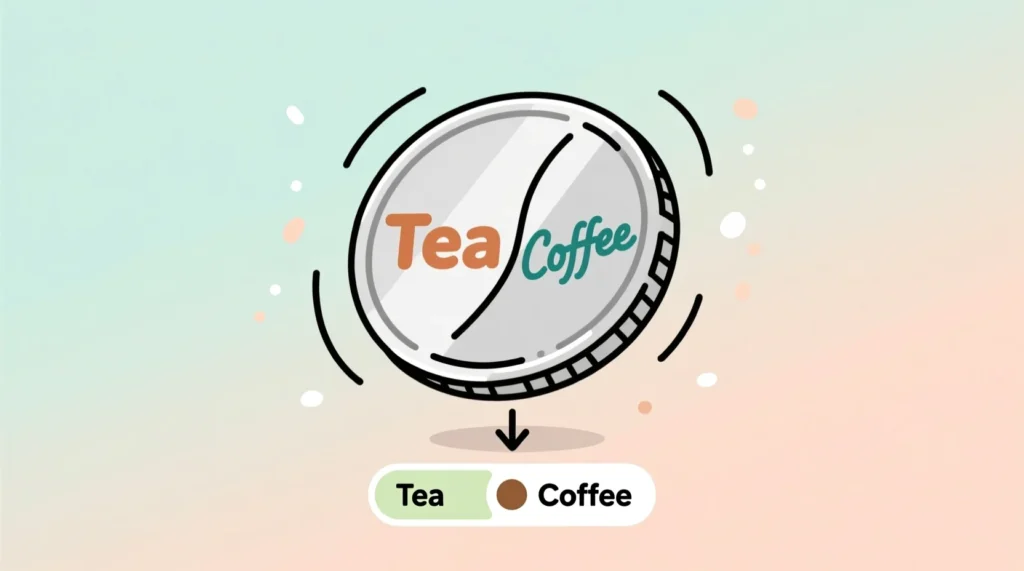
Choosing between tea or coffee for your morning drink — you can’t have both in the same cup at the same time.
In short:
Mutually Exclusive = Cannot happen at the same time = Events or ideas that are completely separate.
🌍 Where Is “Mutually Exclusive” Commonly Used?

- Statistics & Probability 📊 — “Events A and B are mutually exclusive.”
- Logic & Philosophy 🧠 — Contradictory statements cannot both be true.
- Business & Management 💼 — Project choices or strategies that cannot occur together.
- Everyday Life ☕ — Decisions like going out or staying home, buying tea or coffee.
Tone: Neutral, educational ✅
Formality: Can be casual in conversation, formal in academic or business contexts.
💬 Examples of Mutually Exclusive in Sentences

- Flipping a coin:
“Getting heads and tails in one flip is mutually exclusive.”
- Traffic lights:
“The light cannot be red and green at the same time — they are mutually exclusive.”
- Event planning:
“You cannot schedule the meeting for 10 am and 10:30 am at the same time; the times are mutually exclusive.”
- Food choices:
“Choosing pizza or burger for lunch — you can pick only one. These options are mutually exclusive.”
- Logic example:
“The statements ‘I am awake’ and ‘I am asleep’ are mutually exclusive.”
🕓 When to Use and When NOT to Use “Mutually Exclusive”
✅ When to Use
- Explaining probability or statistics
- Logical reasoning
- Decision-making situations with only one possible outcome
- Academic or professional discussions
❌ When Not to Use
- Informal greetings or casual slang
- Situations where events can happen together
- Ambiguous choices
Comparison Table:
| Context | Example Phrase | Why It Works |
|---|---|---|
| Statistics | “Heads and tails are mutually exclusive.” | Clear, precise, factual |
| Business | “These two project plans are mutually exclusive.” | Logical, decision-making |
| Conversation | “Choosing tea or coffee is mutually exclusive.” | Everyday, easy to understand |
| Incorrect Usage | “I like pizza and burger, which are mutually exclusive.” | Not accurate; they can happen together |
🔄 Similar Terms or Alternatives
| Term | Meaning | When to Use |
|---|---|---|
| Exclusive | Only one option allowed | Formal or informal |
| Contradictory | Cannot be true at the same time | Logic, philosophy |
| Incompatible | Cannot coexist | Professional or technical |
| Opposing | Against each other | Everyday or casual context |
| Separate | Not overlapping | Simple explanation |
❓ FAQs About Mutually Exclusive
1. Can two mutually exclusive events happen together?
No, by definition, they cannot occur at the same time.
2. Is mutually exclusive the same as opposite?
Not exactly — opposite means contrary in meaning, while mutually exclusive means cannot occur simultaneously.
3. Is it used in everyday language?
Yes, but often in decisions or choices, e.g., “These two options are mutually exclusive.”
4. How is it used in probability?
If events A and B are mutually exclusive, the probability of both happening together is 0.
5. Can mutually exclusive events have common outcomes?
No, they are completely separate by definition.
📝 Mini Quiz – Test Your Knowledge
1. What does mutually exclusive mean?
a) Can happen together
b) Cannot happen at the same time ✅
c) Are the same
2. Choosing tea or coffee is:
a) Mutually exclusive ✅
b) Not exclusive
c) Opposite
3. Which of these is an example of mutually exclusive events?
a) Getting heads or tails on a coin ✅
b) Wearing shoes and socks ✅
c) Eating pizza and salad
4. Mutually exclusive events are often used in:
a) Probability & logic ✅
b) Casual greetings
c) Random texting
5. If events are mutually exclusive, probability of both occurring = ?
a) 1
b) 0 ✅
c) 0.5
📝 Conclusion
Mutually exclusive is a concept that helps us understand choices, decisions, and logical relationships. It’s used in statistics, logic, business, and everyday life to indicate situations where two things cannot happen at the same time. By understanding this, you can interpret data, make decisions, and explain ideas clearly and accurately.