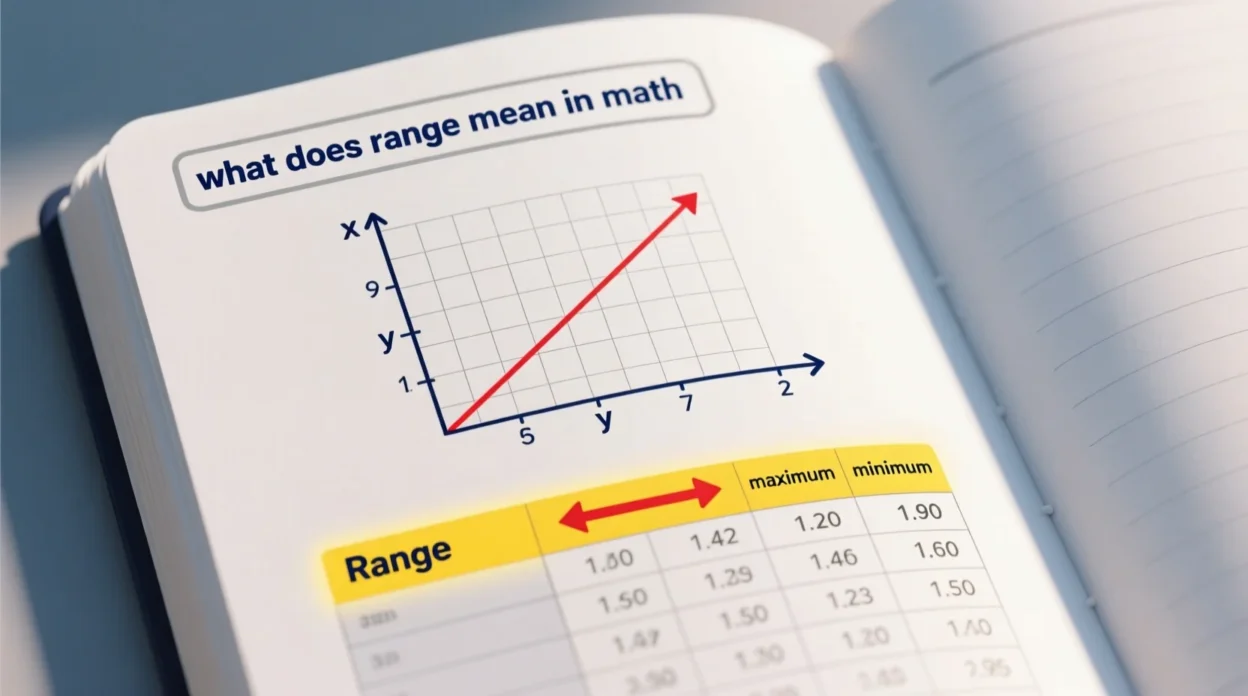
If you’ve ever been solving a math problem—maybe in algebra, functions, or statistics—and suddenly came across the word range, you’re not alone. Many students pause at this term because it sounds simple but is used in multiple places in math. You might have even wondered, “What does range mean in math?” Don’t worry—this article will break it down in the easiest way possible, with examples, comparisons, and clear explanations.
Here’s the quick answer…
Quick Answer:
“Range” in math means the set of all possible output values of a function or the difference between the highest and lowest value in a data set.
🧠 What Does Range Mean in Math?
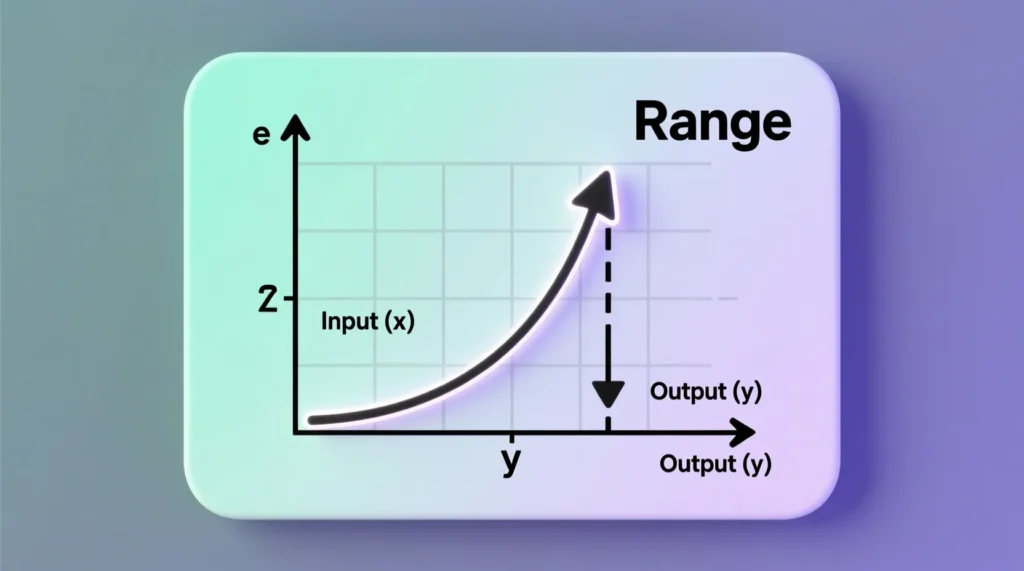
The meaning of range depends on the topic:
1️⃣ In Functions:
The range is all the possible outputs you can get when you put numbers into a function.
- Example: If f(x)=x2f(x) = x^2f(x)=x2, the range is all values from 0 to infinity, because a square can never be negative.
2️⃣ In Statistics/Data:
The range is the difference between the largest and smallest numbers in the data set.
- Example: Data = 2, 8, 10
Range = 10 − 2 = 8
⭐ In short:
Range = all possible outputs OR the spread (max − min).
Bold Summary:
In math: range = output values (functions) OR largest – smallest (statistics).
📱 Where Is “Range” Commonly Used?

You will see the term range used in:
- 📘 Algebra
- 📊 Statistics
- 📈 Graphs & Functions
- 🧮 Calculus
- 🎯 Real-world data analysis
- 🔢 Number sets and intervals
Is it formal or casual?
➡️ Range is a fully formal mathematical term.
💬 Examples of Range in Conversation

Function Examples
A: What’s the range of f(x)=2x+1f(x) = 2x + 1f(x)=2x+1?
B: All real numbers.
A: If f(x)=x2f(x) = x^2f(x)=x2, can the range include –5?
B: No, squares can’t be negative.
Statistics Examples
A: The quiz scores were 50, 65, 70, 90. What’s the range?
B: 90 – 50 = 40.
A: Why is the range so big?
B: Because the values are spread far apart.
School Conversation
A: I don’t get the range of this graph.
B: Just look at how high or low the y-values go.
🕓 When to Use and When NOT to Use “Range”
✅ Use Range When:
- Talking about function outputs
- Discussing statistics
- Comparing data variability
- Finding max–min differences
- Explaining graph behavior
❌ Don’t Use Range When:
- Referring to input values (that’s the domain)
- Talking about geometric distance
- Describing intervals unrelated to math
- Referring to real-life “range” like shooting or cooking
📊 Comparison Table: When Range Works
| Context | Example Phrase | Why It Works |
|---|---|---|
| Algebra | “Find the range of the function.” | Refers to output values |
| Statistics | “Calculate the range of the dataset.” | Measures spread |
| Graphs | “What y-values does the graph reach?” | Range = vertical values |
| Not Math | “What’s the range of this car?” | Not related to math |
🔄 Similar Math Terms or Alternatives
| Term | Meaning | When to Use |
|---|---|---|
| Domain | All input values | When discussing x-values |
| Interval | A portion of numbers between two points | When describing continuous values |
| Mean | Average | Statistics calculations |
| Median | Middle value | Data sets |
| Mode | Most repeated value | Frequency analysis |
| Spread | How far apart values are | Discussing variability |
❓ FAQs About Range in Math
1. Is the range always positive?
No—function ranges can include negative numbers, but statistical ranges are always positive because they are a difference.
2. Are range and domain the same?
No, domain = inputs, range = outputs.
3. Can the range be infinite?
Yes, especially in algebraic functions.
4. Can two datasets have the same range?
Yes, even if their individual numbers differ.
5. How do you find range quickly?
For data: biggest – smallest
For functions: look at y-values on graph or solve logically.
📝 Mini Quiz – Test Your Knowledge
1. What is the range in a data set?
a) Middle value
b) Most repeated value
c) Difference between highest and lowest ✔️
2. If the function is f(x)=x2+3f(x) = x^2 + 3f(x)=x2+3, what is the range?
a) All numbers
b) 3 to infinity ✔️
c) Negative numbers
3. Data = 4, 9, 10, 11. Range = ?
a) 7
b) 5 ✔️
c) 4
4. Range refers to what?
a) Inputs
b) Outputs ✔️
c) Graph slope
5. Range in statistics has to be:
a) Negative
b) Zero
c) Positive ✔️
🏁 Conclusion
Understanding what range means in math makes functions, graphs, and statistics much easier. Whether you’re dealing with equations or data analysis, range helps you understand what outputs are possible or how spread out numbers are. Keep practicing, and soon it’ll feel completely natural!