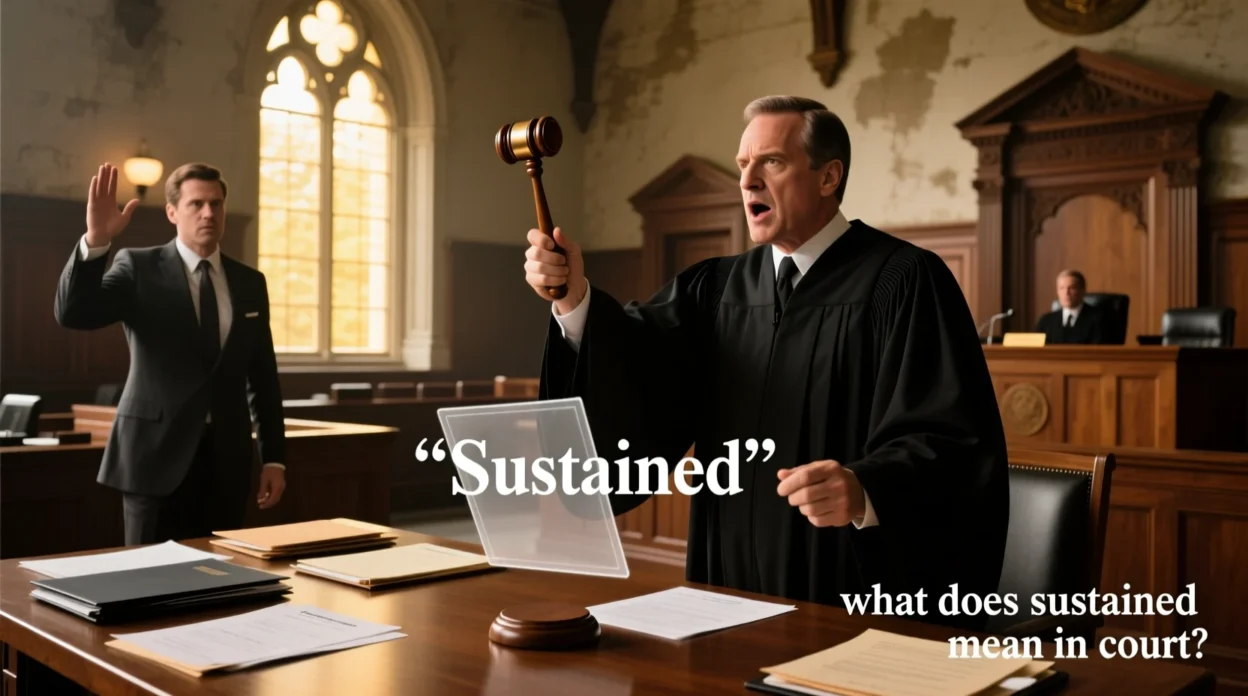
If you’ve ever watched a courtroom movie, a legal drama on Netflix, or sat in an actual court hearing, you’ve probably heard a lawyer shout “Objection!” — and then the judge calmly replies: “Sustained.”
The first time most people hear this word in a courtroom, it sounds formal, intense, and a little confusing. I remember sitting in a traffic court case and hearing “objection sustained,” and I had no idea whether that meant someone won or lost something!
So if you’re reading this because you saw the word in a legal notice, transcript, or courtroom scene, don’t worry. You’re in the right place.
Quick Answer:
“Sustained” means the judge agrees with an objection and stops the question or evidence from continuing.
🧠 What Does Sustained Mean in Court?
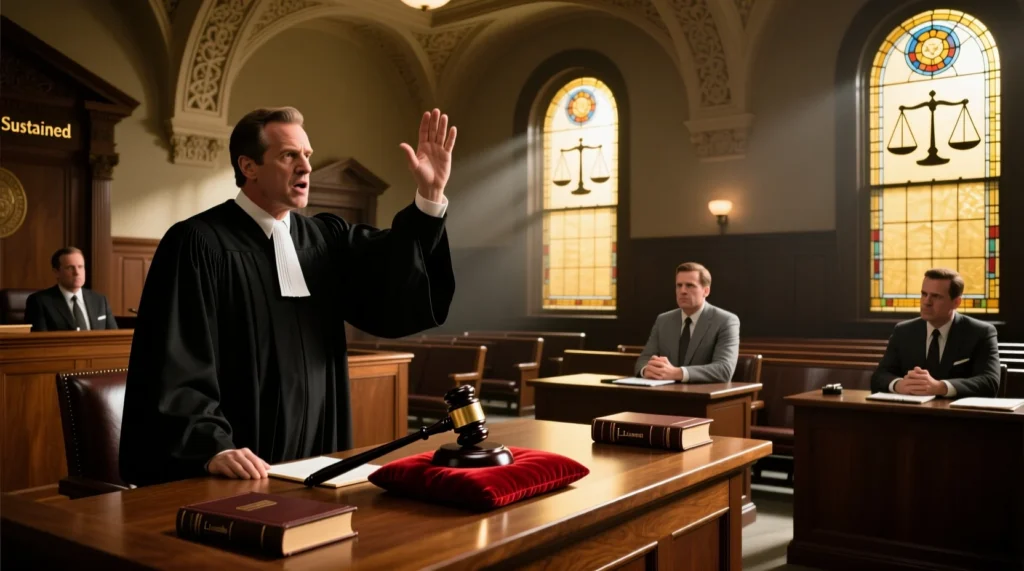
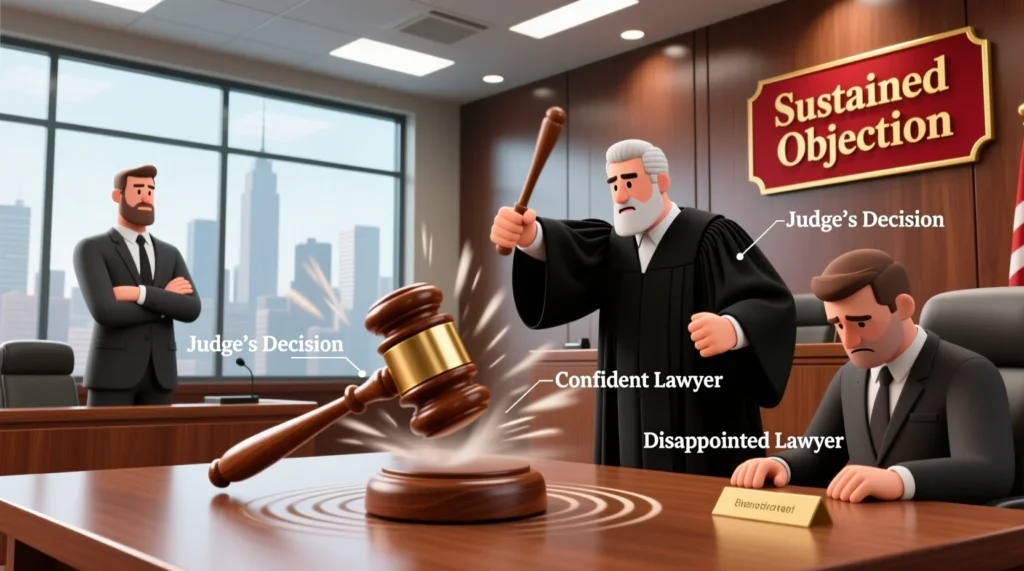
In court, “sustained” means the judge accepts a lawyer’s objection.
This means the judge agrees that a rule was violated, so the question, comment, or evidence must stop or be changed.
Simple Meaning:
A lawyer objects → The judge says “Sustained” → The question or evidence cannot continue as it is.
Example Sentence:
“Objection, hearsay!”
“Sustained. Jury will disregard that statement.”
Bold Summary:
In short: Sustained = Objection accepted = The question or evidence is stopped.
📱 Where Is the Word ‘Sustained’ Commonly Used?
You will find the term sustained mostly in legal or courtroom situations:
- ⚖️ Court hearings
- 🧑⚖️ Judge rulings
- 📄 Legal transcripts
- 🎬 Courtroom movies & TV dramas
- 📰 Case reports & media coverage
- 🧑💼 Law school exams and study materials
Tone:
“Sustained” is a strictly formal legal term, not used in casual texting or slang.
💬 Examples of ‘Sustained’ in Court Conversations
Here are real courtroom-style examples:
1.
Lawyer A: “Objection, irrelevant.”
Judge: “Sustained. Move on, counselor.”
2.
Lawyer: “Did your neighbor tell you what happened?”
Opposing Lawyer: “Objection, hearsay.”
Judge: “Sustained. Witness cannot answer.”
3.
Lawyer: “Isn’t it true you were angry that day?”
Opposing Lawyer: “Objection, leading.”
Judge: “Sustained. Rephrase the question.”
4.
Prosecutor: “The defendant always lies—”
Defense: “Objection, argumentative.”
Judge: “Sustained. Jury will disregard.”
5.
Defense: “He told me he saw the suspect—”
Prosecutor: “Objection, speculation.”
Judge: “Sustained.”
6.
Witness: “I think he was drunk.”
Attorney: “Objection, conclusion.”
Judge: “Sustained. Only state what you observed.”
🕓 When to Use and When NOT to Use ‘Sustained’ in Court
✅ When to Use
Use “sustained” only when:
- A judge is responding to an objection
- A question breaks a legal rule
- Evidence is not allowed
- A lawyer challenges improper questioning
- A procedural rule is violated
❌ When NOT to Use
Avoid using it:
- In normal conversation
- In texting or slang
- In non-legal writing
- As a replacement for words like “approved” or “accepted”
- Outside of objection rulings
📊 Comparison Table
| Context | Phrase | Why It Works |
|---|---|---|
| Courtroom | “Objection.” “Sustained.” | Formal legal usage |
| Legal Writing | “The objection was sustained.” | Correct technical tone |
| Everyday Talking | “The judge agreed.” | Clear and understandable |
| Casual Chat | “Yeah, true.” | Friendly replacement |
| Emails | “Your request is approved.” | Professional equivalent |
🔄 Similar Legal Terms or Alternatives
| Term | Meaning | When to Use |
|---|---|---|
| Overruled | Judge rejects the objection | Opposite of sustained |
| Objection | Lawyer challenges a question | Before the judge rules |
| Admissible | Allowed as evidence | Evidence discussions |
| Inadmissible | Not allowed as evidence | When evidence breaks rules |
| Relevance | Connected to the case | To challenge irrelevant info |
❓ FAQs About “Sustained” in Court
1. What is the opposite of sustained?
Overruled. It means the judge disagrees with the objection.
2. When a judge says sustained, who “wins”?
The lawyer who made the objection wins that point.
3. Does “sustained” mean the case is finished?
No — it refers only to specific objections during trial.
4. Can a witness continue after a sustained objection?
Not until the lawyer rephrases or changes the question.
5. Is “sustained” used in every country?
Many English-speaking legal systems use it, but not all.
6. Does sustained mean evidence is rejected?
Yes — if the objection was about evidence, it becomes inadmissible.
7. Why do judges say it so quickly?
Because trials follow strict rules and move fast.
📝 Mini Quiz – Test Your Knowledge
1. “Sustained” means:
a) Objection denied
b) Objection accepted ✅
c) Case closed
2. Opposite of “sustained” is:
a) Approved
b) Allowed
c) Overruled ✅
3. Which is a correct courtroom example?
a) “Sustained! Continue talking.”
b) “Sustained. Witness will not answer.” ✅
c) “Sustained. You win the case.”
4. “Sustained” is used in:
a) Courtrooms only ✅
b) Text messages
c) Everyday conversation
5. If an objection is sustained, the question is:
a) Allowed
b) Stopped or changed ✅
c) Ignored
📝 Conclusion
“Sustained” is one of the most common words you’ll hear in courtrooms, movies, and legal documents. It simply means the judge agrees with a lawyer’s objection and stops the question or evidence from continuing. While the word sounds formal and intimidating, its meaning is straightforward: objection accepted.
Understanding terms like sustained, overruled, and objection helps you follow legal conversations more easily — whether you’re studying law, watching a trial, or decoding a legal transcript.